
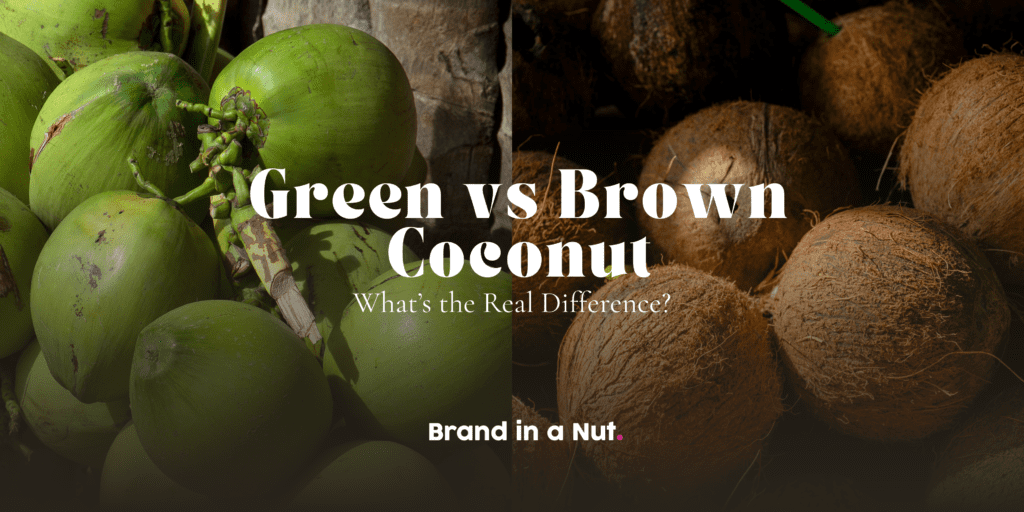
Walk into any market and you might see two very different coconuts sitting side by side: one smooth and green, the other hard and brown with a fibrous shell. At first glance, they look like completely different fruits. Many people assume they come from different trees or belong to separate varieties.
In reality, green and brown coconuts are the same fruit — just harvested at different stages of maturity.
The difference between green and brown coconuts is not about species, but about age, structure, water content, and intended use. As a coconut matures, its flavor, texture, and nutritional composition shift significantly. Understanding these differences helps explain why one coconut is best for hydration while the other is ideal for cooking.
This guide breaks down green vs brown coconut in detail — from structure and taste to nutrition and culinary application.
Key Takeaways
- Green and brown coconuts are the same fruit at different stages of maturity
- Green coconuts are harvested young and contain more water
- Brown coconuts are fully mature and contain thicker meat
- Flavor becomes richer and slightly nuttier as coconuts mature
- Texture shifts from soft and jelly-like to firm and dense
- Green coconuts are best for drinking and hydration
- Brown coconuts are best for cooking, milk, and oil production
What Is a Green Coconut?
A green coconut is simply a young, immature coconut harvested before it reaches full maturity. At this stage, the fruit is still developing internally. The outer husk remains green (or sometimes yellow depending on variety), and the interior is dominated by coconut water.
Structural Characteristics
- Smooth green or yellow outer husk
- Thick fibrous layer beneath the surface
- Large volume of coconut water
- Thin, soft interior meat
When opened, a green coconut reveals clear, lightly sweet coconut water and a soft, jelly-like layer of meat lining the inside of the shell.
Water Content
Green coconuts are prized for hydration because they contain significantly more liquid than mature coconuts. The water is naturally occurring and forms as part of the coconut’s development.
Flavor Profile
Green coconut water tastes:
- Light
- Clean
- Mildly sweet
- Refreshing
It does not taste heavy, syrupy, or strongly nutty. Its sweetness is subtle and balanced.
Typical Uses
Green coconuts are commonly used for:
- Fresh drinking
- Hydration in warm climates
- Wellness and fitness settings
- Light beverages
At this stage, the coconut is about refreshment rather than richness.
What Is a Brown Coconut?
A brown coconut represents the fully mature stage of the same fruit. As the coconut ages, the outer green husk dries out and turns brown. In many markets, this outer husk is removed entirely, revealing the hard brown shell underneath.
Structural Characteristics
- Brown fibrous exterior (after husk removal)
- Very hard inner shell
- Reduced water content
- Thick, firm white meat
The internal composition changes dramatically. The water volume decreases, and the white flesh lining the shell becomes thicker and more solid.
Flavor Profile
Brown coconut meat tastes:
- Richer
- Slightly nuttier
- More concentrated
- Mildly sweet but less refreshing
While brown coconuts still contain water, it is usually less abundant and less emphasized.
Typical Uses
Brown coconuts are commonly used for:
- Coconut milk
- Coconut cream
- Baking
- Shredded coconut
- Coconut oil production
At this stage, the coconut becomes a culinary ingredient rather than primarily a beverage.
Structural Differences Between Green and Brown Coconuts
Understanding the structural differences clarifies why these coconuts function so differently.
A coconut consists of several layers:
- Outer husk (exocarp + mesocarp)
- Hard inner shell (endocarp)
- Coconut water
- Coconut meat
As the fruit matures:
- The water decreases
- The meat thickens
- The shell hardens
- The exterior dries
Structural Comparison
| Feature | Green Coconut | Brown Coconut |
| Stage | Immature | Fully mature |
| Water Volume | High | Lower |
| Meat Thickness | Thin & soft | Thick & firm |
| Husk Color | Green/yellow | Brown (after husk removal) |
| Shell Hardness | Developing | Very hard |
The internal transformation from liquid-dominant to meat-dominant defines the core difference between green and brown coconuts.
Flavor Differences: Green vs Brown Coconut
The shift from green to brown coconut directly affects flavor.
Green Coconut Flavor
Green coconut water is:
- Crisp
- Subtly sweet
- Clean
- Light
It feels hydrating and refreshing. The sweetness is mild and never overpowering.
The soft meat carries a similar delicate sweetness, with a texture that enhances the perception of freshness.
Brown Coconut Flavor
Brown coconut meat tastes:
- Slightly nuttier
- More concentrated
- Fuller in body
The reduction in water and increase in flesh density makes the flavor feel heavier. It is still mild compared to many fruits, but it has more structure and depth.
Why Flavor Changes
As water decreases, the relative concentration of fats and solids increases. This alters how sweetness and richness are perceived.
Green coconuts feel refreshing.
Brown coconuts feel substantial.
Texture Differences: Soft vs Firm
Texture is one of the most noticeable differences between green and brown coconuts.
Green Coconut Texture
- Jelly-like meat
- Soft and spoonable
- Smooth hydration
The meat feels almost custard-like in young coconuts. Combined with high water content, it creates a light, clean mouthfeel.
Brown Coconut Texture
- Thick
- Firm
- Slightly chewy
The dense flesh makes brown coconut ideal for grating or shredding. It holds structure during cooking.
Texture and Flavor Perception
Soft textures often feel sweeter because they dissolve easily and coat the palate lightly. Firm textures feel richer and heavier, even when sugar levels are similar.
Texture plays a major role in how coconut is experienced.
Culinary Uses: When to Use Each
Different culinary goals require different coconut stages.
Best Uses Comparison
| Use | Green Coconut | Brown Coconut |
| Drinking fresh | ✓ Best option | Limited |
| Coconut milk | Not ideal | ✓ Best option |
| Baking | Rarely used | ✓ Common |
| Hydration | ✓ Excellent | Minimal |
| Oil production | No | ✓ Yes |
When to Choose Green Coconut
- When hydration is the priority
- When serving fresh coconut water
- When a light, refreshing profile is desired
When to Choose Brown Coconut
- When making coconut milk or cream
- When cooking savory dishes
- When baking
- When extracting oil
The intended use should determine which stage of coconut is selected.
Nutritional Differences Between Green and Brown Coconuts
As the coconut matures, its nutritional composition shifts.
Green Coconut Nutrition
- Higher water content
- Lower fat
- Naturally occurring electrolytes
- Lower calorie density
Green coconut water is valued for hydration due to potassium and other electrolytes.
Brown Coconut Nutrition
- Higher fat content
- Higher calorie density
- More fiber
- Greater concentration of nutrients per gram
The thick meat contains more natural fats, which makes it suitable for milk and oil extraction.
The nutritional differences reflect the structural transformation from liquid-dominant fruit to dense seed.
Common Myths About Green vs Brown Coconut
Myth 1: They Are Different Species
They are the same fruit at different stages of maturity.
Myth 2: Brown Coconuts Are Always Sweeter
Green coconuts can taste sweeter due to higher water volume and lighter mouthfeel.
Myth 3: Brown Coconuts Have No Water
They still contain water, but much less than green coconuts.
Myth 4: Green Coconuts Cannot Be Used for Cooking
While less common, young coconut meat can be incorporated into dishes for texture.
Understanding maturity eliminates confusion.
Conclusion — Understanding Maturity Changes Everything
Green and brown coconuts are not different fruits. They represent two stages in the same lifecycle — one focused on hydration, the other on richness.
Green coconuts offer lightness, clarity, and refreshment.
Brown coconuts offer density, structure, and culinary depth.
Choosing the right stage depends entirely on the intended purpose.
Recognizing this difference also explains why young coconuts are often selected for fresh drinking experiences and refined presentation, while mature coconuts are reserved for cooking and processing. The stage of the coconut defines not only its flavor and texture, but the entire experience it delivers.
FAQs — Green vs Brown Coconut
-
Are green and brown coconuts different types?
No. They are the same fruit harvested at different stages of maturity.
-
Which coconut is sweeter?
Green coconuts often taste sweeter due to higher water content and lighter texture.
-
Can you drink water from a brown coconut?
Yes, but it contains less water and may taste slightly different.
-
Which coconut is healthier?
Both offer benefits. Green coconuts are hydrating; brown coconuts provide more fat and fiber.
-
Why does brown coconut have less water?
As the fruit matures, water is gradually converted into solid meat.
-
Is coconut water clearer in green coconuts?
Yes. Fresh green coconut water is typically clear when first opened.

