
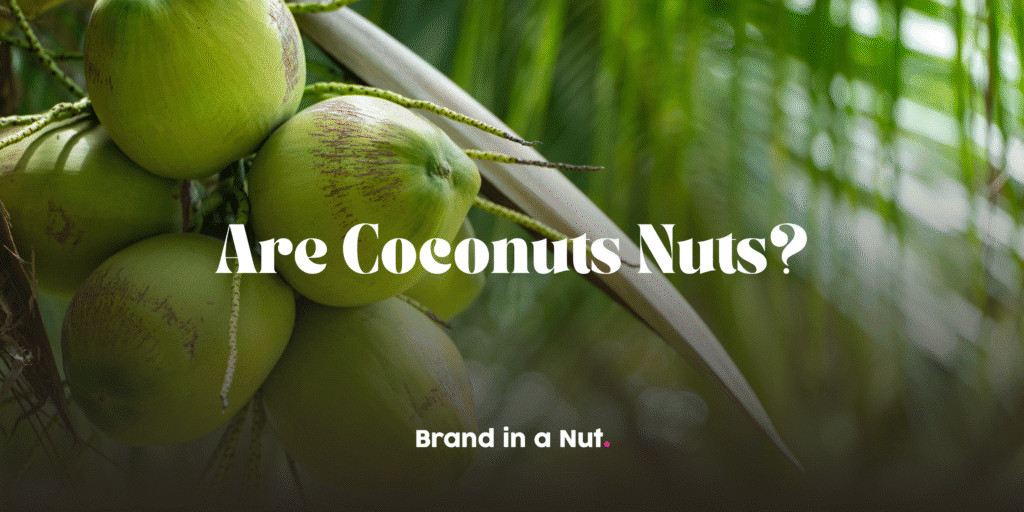
Are coconuts nuts? The very name coconut suggests it might be, yet the truth is more complex. This tropical staple defies simple labels – botanically it’s not a true nut at all. Many people are surprised to learn that despite having “nut” in its name, the coconut is a unique fruit with characteristics of a seed, a nut (in the loose sense), and something entirely its own. In this article, we’ll delve into the science of what coconuts really are, explore the botanical debate (fruit, seed, or nut?), examine the nutritional profile versus true tree nuts, clear up confusion around coconut allergies, and look at the rich history and cultural uses of this fascinating fruit. By the end, you’ll have a clear answer – grounded in science and evidence – to the question: Are coconuts nuts?
What Exactly Is a Coconut?
Scientific Identity: The coconut we know comes from the coconut palm tree (Cocos nucifera), a member of the palm family (Arecaceae). These palms thrive in tropical regions around the world and produce the large, iconic fruits we call coconuts. Botanically speaking, a coconut is a fibrous one-seeded drupe – essentially a dry, one-seeded fruit. This means it has multiple layers surrounding a single seed.

Structure of a Coconut:
A coconut’s fruit is made up of three main layers:
- Exocarp: the outermost skin, which on a fresh coconut is smooth and green or yellowish. This is the part you rarely see in store-bought coconuts because it’s usually removed.
- Mesocarp: the middle layer, a thick, fibrous husk (called coir). This fibrous husk is what makes coconuts buoyant in water and has many uses (as we’ll see later). Together, the exocarp + mesocarp form the tough husk of the coconut.
- Endocarp: the hard inner shell that we typically recognize as a “coconut.” This woody shell (about a quarter-inch thick) has the familiar three “eyes” or pores at one end. Inside the shell is the seed itself.
When you buy a whole coconut at the market, it has usually been de-husked – you’re seeing the brown endocarp shell with those three dimples. Inside the shell is the seed’s endosperm. Part of this endosperm is liquid (the coconut water) and part of it is solid (the white fleshy coconut meat). In fact, the white edible part of a coconut is the endosperm of the seed – that’s the “meat” we eat or shred for cooking. The coconut water is the liquid endosperm that eventually solidifies as the fruit matures.
So, a coconut is not a simple nut in the shell; it’s a whole fruit containing a seed. It has a husk, a hard shell, and nourishing meat and water inside. This unusual structure sets the stage for why there’s confusion about what to call it.
The Botanical Debate — Fruit, Seed, or Nut?
Coconuts spark a classic classification debate: are they fruits, seeds, or nuts? The answer can be “all of the above,” depending on definitions. Let’s break it down:
-
Fruit:
In botanical terms, any seed-bearing structure formed from the ovary of a flowering plant is a fruit. By this strict definition, a coconut is a fruit – specifically a drupe. It develops from the coconut flower and contains the seed. Botanists classify coconut as a one-seeded drupe (a dry drupe). Like peaches, plums, or cherries (which are fleshy drupes), a coconut has its seed enclosed in a hard endocarp. But unlike those juicy drupes, coconut’s mesocarp is dry and fibrous, not soft.
-
Seed:
A coconut can also legitimately be called a seed. A seed is the reproductive unit of a plant – essentially a “baby plant” in a protective coat with a food supply. If you shake a coconut and hear sloshing, that’s the liquid endosperm feeding the seed embryo. When a coconut germinates, a shoot actually sprouts out of one of the three pores (“eyes”) on the endocarp. The new palm uses the coconut’s rich endosperm (meat and water) as nourishment to grow. In this sense, the entire coconut (shell and all) functions as a large seed that can float to new locations and sprout a new tree. This is why some scientists refer to coconuts as “water-dispersed seeds” – they can drift across oceans and colonize distant shores.
-
Nut:
In common language, we call many one-seeded fruits “nuts.” By a loose definition, a nut is any hard-shelled, one-seeded fruit – and by that measure a coconut qualifies as a nut. However, in strict botanical terms, a coconut is not a true nut. A “true nut” (like an acorn or a hazelnut) is a dry fruit that does not split open at maturity to release its seed; the seed and fruit are one and the same, and the fruit wall is very hard. True nuts usually come from a compound ovary and typically have a single seed.
Coconuts differ: they have that distinct three-layer structure and don’t cleanly fit the nut criteria. The coconut’s hard shell does not crack open on its own to free the seed; instead, the seedling grows out of the shell. This ability to germinate without the fruit cracking is one reason botanists set coconuts apart from true nuts.
In summary, a coconut is a drupe (fruit) that contains a seed, and loosely can be called a nut. As the U.S. Library of Congress puts it: “Botanically speaking, a coconut is a fibrous one-seeded drupe… However, when using loose definitions, the coconut can be all three: a fruit, a nut, and a seed.”. It’s a wonderful example of how nature resists our tidy categories. So if you’ve been confused about the coconut’s identity, you weren’t wrong – it wears many hats!
The Nutritional Perspective
Beyond botany, what does a coconut offer nutritionally, and how does it compare to true tree nuts like almonds or walnuts? Coconut is used in many forms – coconut meat, coconut water, coconut milk, coconut oil – each with a different nutritional profile.
Coconut Meat (Flesh):
The white flesh inside the coconut is high in fat and fiber. It has a rich, creamy texture when fresh (or a dry, chewy texture when desiccated). Unsweetened dried coconut meat is quite calorie-dense. For example, just one ounce (28 grams) of unsweetened shredded coconut meat provides about 185 calories, 18 grams of fat, 7 grams of carbohydrates, and 2 grams of protein. It also contributes important minerals like potassium, iron, copper, and manganese. Coconut fat is unique among plant fats because it is predominantly saturated fat – largely medium-chain triglycerides (like lauric acid). This is in contrast to most nuts (almonds, walnuts, etc.), which are rich in unsaturated fats and contain more protein.
To put it in perspective, coconut meat is much lower in protein and higher in saturated fat than tree nuts. Almonds, for instance, have over 20 grams of protein per 100g, whereas coconut has only about 3 grams per 100g. The fats in almonds, walnuts, etc. are mostly monounsaturated or polyunsaturated (known to support heart health), while coconut’s fat is ~89-90% saturated. Coconut oil, which is extracted from the meat, is about 90% saturated fat – higher than butter or lard in that regard. This saturated fat can raise LDL (“bad”) cholesterol levels, which is why health experts often caution against treating coconut oil as a “health food” despite trendy claims. (It’s worth noting coconut oil may also raise HDL cholesterol somewhat, but it’s still not as heart-healthy as oils rich in unsaturated fats.)
Coconut Water:
In contrast, coconut water (the clear liquid inside young coconuts) is fat-free, low in calories, and rich in electrolytes. About one cup of pure coconut water has around 45–60 calories. It contains important electrolytes like potassium, magnesium, sodium, and calcium. This composition has led to coconut water being marketed as a natural sports drink. Indeed, coconut water has a greater variety of electrolytes and less added sugar compared to commercial sports drinks. It is also less acidic. However, experts note that for most casual hydration needs, plain water is sufficient – coconut water’s real benefit is its pleasant taste and electrolytes for those who need them. Fun fact: during WWII, doctors reportedly used sterile coconut water as an emergency IV fluid when conventional saline was unavailable, thanks to its electrolyte balance!
Coconut Milk and Others:
Coconut milk (made by grinding coconut meat with water) is high in fat and calories, because it carries the richness of the coconut meat. It can add around 450 calories and 48g of fat per cup (for canned coconut milk), so moderation is key. Coconut flour (defatted, powdered coconut meat) is high in fiber. Coconut sugar (made from sap of the flower) is still a sugar, though with a lower glycemic index than cane sugar.
Compared to Tree Nuts:
Tree nuts like almonds, walnuts, cashews, etc., are valued for their protein, healthy fats, vitamin E, and other micronutrients. Coconut is more comparable to a starchy fruit/seed in nutrition – high energy from fats, but not a protein source like nuts are. Most tree nuts also contain omega-3 or omega-6 fatty acids and are linked to heart-health benefits. Coconut’s high saturated fat means it should be enjoyed as part of a balanced diet, not as a direct substitute for the heart-healthy nuts. That said, coconut does provide some unique nutrients (like those medium-chain fats which are metabolized a bit differently than long-chain fats, and significant manganese for metabolism). In tropical cultures, coconut flesh has been a staple food for centuries, and people traditionally balanced it with other foods (fish, tubers, fruits, etc.).
In short, nutritionally, coconut is neither superior nor directly equivalent to true nuts – it’s a different kind of food. It offers fiber, minerals, and fuel (especially in physically active tropical lifestyles), but it lacks the high protein and unsaturated fat profile that make nuts a healthful snack. As with most foods, moderation is key. Enjoy coconut for its flavor and benefits, but be aware of the calorie-dense fat content.
Coconut Allergies vs. Tree Nut Allergies
The word “nut” in coconut also causes confusion when it comes to food allergies. Tree nut allergies are common and can be severe – so where does coconut stand? Interestingly, coconut allergy is very uncommon, and coconut is not closely related to tree nuts botanically. Most people with tree nut allergies can eat coconut without problems. However, the situation has been muddied by labeling laws and caution in the medical community.
FDA Classification (Past and Present):
In the United States, the Food and Drug Administration historically included coconut in the definition of “tree nuts” for the purpose of allergen labeling. Starting in 2006, U.S. law (the Food Allergen Labeling and Consumer Protection Act) required coconut to be labeled as an allergen on packaged foods if present, right alongside almonds, walnuts, and other true nuts. This was done out of an abundance of caution, even though coconut allergy was rare. For years, coconut appeared in allergen warnings like “Contains: Tree nuts (coconut)”. This has recently changed – as of the FDA’s 2025 updated guidance, coconut has been removed from the “major food allergen” tree nut list In other words, regulators acknowledged that coconut doesn’t have the same allergenic profile as tree nuts. (Other obscure “nuts” like shea nut and pine nut were also taken off the list in the new guidance.)
Allergy Reality:
According to allergy experts, “Coconut is not a botanical nut; it is classified as a fruit… While allergic reactions to coconut have been documented, most people who are allergic to tree nuts can safely eat coconut.”. The American College of Allergy, Asthma & Immunology notes that if you have a tree nut allergy, you should talk to your allergist, but coconut is usually well-tolerated. Empirical data back this up: a 2023 study estimated only about 0.4% of Americans (roughly 1 in 260 people) report any coconut allergy symptoms, and fewer than half of those had a confirmed physician diagnosis. By comparison, around 1% of the U.S. population has tree nut allergies and up to 2% have peanut allergies. So coconut allergy is quite rare.
Why the discrepancy? The proteins that trigger tree nut allergies are different from those in coconut. Being allergic to walnuts or almonds doesn’t automatically mean you’ll react to coconut, because they are not from related plant families. Coconut comes from palm trees, not from the nut-bearing trees like walnut, almond, cashew, etc. Of course, any food can cause an allergy in some individuals, and there are indeed people allergic to coconut (or coconut oil, coconut water, etc.). Such individuals must avoid coconut just as others avoid nuts. But the vast majority of nut-allergic people do not need to avoid coconut – and allergists often permit coconut in nut-free diets, especially now that the FDA has adjusted its stance.
Historical and Cultural Classification
Coconuts have a rich history intertwined with human travel, trade, and culture. Understanding this background also sheds light on why we call it a nut and how coconuts spread around the world.
Origins and Dispersal:
Botanists and historians have long debated where coconuts originally came from. The consensus today is that coconut palms originated in the Indo-Pacific region, likely around Southeast Asia or Melanesia. There is evidence of ancient cultivation in what is now Malaysia, Indonesia, and the Pacific islands. One renowned palm researcher, Odoardo Beccari, argued in the early 1900s that coconuts are an Old World plant, noting the greater variety of coconut types in the Eastern hemisphere (implying a longer history there).
On the other hand, some scientists historically speculated coconuts could have floated their way to the New World (South America) and even originated there, but modern genetic studies favor an Austronesian dispersal via seafaring peoples. Austronesian sailors carried coconuts on their canoes as they colonized Pacific islands, using them as a vital source of food and water (hence the nickname “the tree of life”). Once Europeans entered the picture (1500s onward), they transported coconuts to new places like the west coast of Africa and the Caribbean. Today, coconut palms are cosmopolitan across the tropics.
The Name “Coconut”:
The word coconut has an interesting origin. It comes from the 16th-century Portuguese and Spanish word “coco,” meaning a head or skull, because the three holes on the coconut shell resembled a face to European explorers. These explorers encountered coconuts during expeditions (for example, the crew of Vasco da Gama or Magellan in the early 1500s) and the name stuck.
Before that, in Marco Polo’s 13th-century writings, he referred to coconuts as “nux indica” – Latin for “Indian nut” – a term he picked up from Arabic jawz al-Hindi (which also means “Indian nut”).
In fact, one of the earliest written descriptions of the coconut, by a traveler named Cosmas in the 6th century AD, calls it the “great nut of India.” The use of “nut” was a convenient way for foreigners to describe this unfamiliar fruit. So, calling it a “nut” was basically a colonial/trade simplification for something that didn’t fit known categories at the time.
Over time, European languages settled on the word cocoanut (an older spelling) and eventually coconut. Despite the scientific reclassification as a drupe, the common name never changed – it had been coconut for centuries, and so it remains. The legacy of the word “nut” in its name is historical; it does not mean botanists consider it a true nut.
Cultural Uses and Significance:
Coconuts are deeply ingrained in many cultures:
- In tropical Asia-Pacific regions, every part of the coconut palm is utilized, earning it names like “Tree of Life.” The fruit provides drink (coconut water), food (meat, milk, oil), fiber (coir from husk), fuel (dried shells can be burned, or made into charcoal), and even building material (the leaves and wood). This incredible utility made coconut palms hugely important to island and coastal communities. For example, historical accounts from Arab traders in the 9th century describe how people in Southeast Asia used coir fiber for ropes and toddy (fermented coconut sap) as a drink.
- In religion and rituals, coconuts take on symbolic roles. In Hindu tradition, the coconut is revered and used in offerings and ceremonies. A coconut may be decorated and offered to deities during worship as a symbol of prosperity and purity. Breaking a coconut at the start of a new venture is a common practice in India, intended to invoke divine blessing. In some parts of the Philippines, coconuts feature in ancestral offerings (for example, filling coconut shells with sticky rice and eggs as an offering to the dead). The coconut’s presence in cultural rituals underscores its value beyond just food.
- In folklore and myth, coconuts often appear. Many Pacific island myths tell of the origin of the coconut – for instance, the Polynesian story of Sina and the Eel explains the coconut’s face-like appearance as originating from a buried eel (the spots on the shell are the eel’s features, in the myth). An urban legend even claims more people are killed by falling coconuts than by sharks each year (a statistic often debunked but endlessly repeated as a quirky factoid).
Historical trade:
Coconuts were an important trade commodity. The coir fiber was prized for making ropes (it was used in ship riggings and is still used for cordage and mats). In fact, by the 1800s and 1900s, coconut products like copra (dried coconut meat, used for oil extraction) became major exports from places like the Philippines, Ceylon (Sri Lanka), and Pacific islands. This global trade further cemented the coconut’s status as a world crop, even if European botanists scratched their heads on how to classify it.
From being a Mardi Gras token in New Orleans (where hand-decorated coconuts are treasured parade throws) to a carnival game prize in England’s traditional “coconut shy”, the coconut finds its way into culture in playful ways too. It’s fair to say few fruits have had such a broad impact on human life and imagination as the humble coconut.
Fun Facts & Modern Applications
Coconuts come with their share of fun facts and modern-day innovations:
-
Natural Sports Drink:
Coconut water’s electrolyte profile has led to a boom in bottled coconut water as a natural alternative to sports drinks. It contains potassium, magnesium, calcium, and sodium, making it a natural isotonic beverage. While it may not magically outperform plain water for hydration, it’s a tasty, lower-sugar way to replenish some electrolytes. Many athletes in tropical countries drink it straight from the fruit.
-
Medical Emergency Use:
As mentioned earlier, during World War II and the Vietnam War, doctors occasionally used coconut water as an intravenous fluid substitute when conventional IV saline was unavailable. The sterile water from inside a fresh coconut could be directly transfused because it is very similar to the electrolyte composition of human plasma. This isn’t common practice today, but it’s a remarkable historical footnote that speaks to coconut water’s purity.
-
Coir and Industrial Uses:
The fibrous husk (mesocarp) yields coir fiber, which has been used for centuries to make ropes, mats, brushes, sacks, and even as caulking for boats. Today, coir is also used as an eco-friendly material in gardening (for potting soil mixes and hanging basket liners) and even for erosion control mats. It’s rot-resistant and sustainable. If you have a stiff bristly doormat or a scrub brush, there’s a good chance it’s made of coir from coconut husks.
-
Every Bit is Used:
In traditional communities, literally every part of the coconut palm is put to use. The leaves thatch roofs or weave into baskets; the trunk wood can be used as lumber; the coconut shell becomes bowls, charcoal, or handicrafts; the coconut oil is used in cooking, soap-making, and cosmetics. This total utilization is why the palm is affectionately called “Kalpavriksha” (tree of heaven) in Sanskrit or “Tree of Life” in the Philippines.
-
Modern Branding and Novelty:

Believe it or not, coconuts have also entered the world of marketing and events in creative ways. Custom-branded coconuts have become a trendy novelty at tropical-themed weddings, beach festivals, and corporate events. Imagine attending an event and being handed a fresh coconut with a company’s logo or a couple’s monogram laser-etched or stamped on the shell – it happens! This experiential marketing idea gives guests a memorable (and Instagrammable) experience. Sipping coconut water straight from a personalized coconut is certainly a conversation starter. Companies like Mr. Coconut (in India) and others worldwide now provide these services, turning coconuts into natural billboards for a bit of fun branding.
-
Fun Folklore:
The infamous “coconut vs. shark” statistic mentioned above is often cited as a humorous reminder not to fear shark attacks too much – supposedly coconuts injure or kill more people by falling on their heads. While the actual numbers are hard to verify, it is true that in areas with many tall coconut palms, falling coconuts can be a real hazard (helmets for harvesters are a thing!). Always look up if napping under a loaded coconut tree!
-
Coconut in Pop Culture:
From Monty Python using coconut halves to mimic horse hoof sounds, to the classic tropical cocktail piña colada (pineapple with coconut cream) being the quintessential island drink, coconuts firmly occupy a niche in pop culture as a symbol of the tropics and good vibes. They even star in a viral internet meme song (“Coconut nut is a giant nut…”). 🥥
In essence, the coconut continues to evolve in its uses – old and new. Whether as a health drink, a source of eco-friendly materials, or a cheeky promotional item, it never ceases to amaze how one fruit can be so versatile.
So… Are Coconuts Nuts? The Final Answer
Time to answer the big question clearly: No, botanically speaking, coconuts are not true nuts. They are drupe fruits. The coconut is a one-seeded fibrous drupe – a fruit with a hard shell enclosing the seed. It shares this category with fruits like peaches and almonds (almond seeds are inside a drupe shell too!). True nuts (like acorns or hazelnuts) have a different botanical structure, and coconuts don’t fit that bill.
However, calling a coconut a nut isn’t completely wrong in everyday language. Historically it was called a nut (e.g., “Indian nut” by early travelers), and even scientifically you could say it’s a nut in the loose sense of being a one-seeded fruit. But if you want to be precise: a coconut is a fruit and a seed, but not a nut. 🌴
From a legal/allergy standpoint, for many years coconut was grouped with tree nuts simply for safety labeling. That was a cautionary approach, not a botanical one. Now that has changed (the FDA no longer deems coconut a major tree nut allergen), reflecting what science knew all along – coconut is quite distinct from true nuts.
From a nutritional perspective, coconut stands apart from tree nuts. It doesn’t provide the same protein punch or heart-healthy fats; instead it offers a lot of saturated fat and fiber, more akin to a starchy energy-rich fruit or seed. So nutritionally, treating coconut as its own category makes sense too.
Frequently Asked Questions About Coconuts
-
Do coconuts have seeds?
Yes. A whole coconut is actually a seed. The largest seed in the world—that can germinate into a new palm tree.
-
Do palm trees grow coconuts?
Only coconut palm trees (Cocos nucifera) grow coconuts. Other types of palms, like date palms, produce different fruits.
-
What color are coconuts?
Young coconuts are green or yellow on the outside. As they mature, the husk turns brown and fibrous, revealing the familiar hard shell.
-
What does coconut meat taste like?
Coconut meat is mildly sweet, nutty, and creamy. Young coconut flesh is soft and jelly-like, while mature coconut meat is firm and chewy.

